
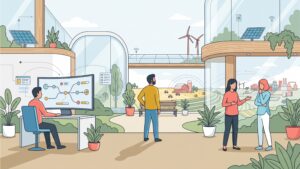
 Resources from my keynote ‘Built to Thrive’ given on 5 November 2026.
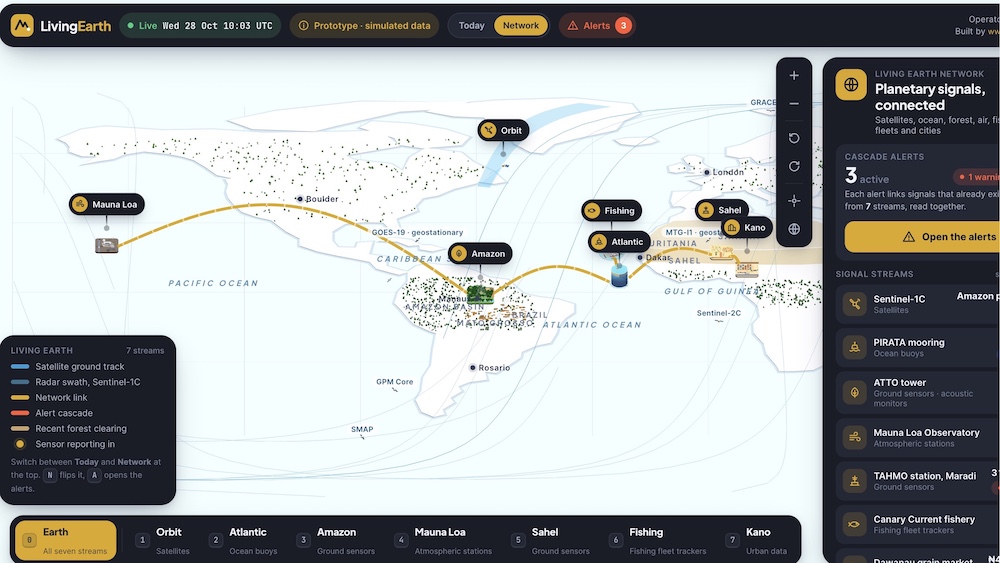
To show what good between humans and AI looks like, I built a “living earth network” in an afternoon using an LLM, with no coding background. It runs on simulated data. It isn’t a product and it isn’t for sale. But if one person can do that alone, think about what this community could build together.
Here’s what I asked the room to take away.
1. Experiment, but bring people with you.
Try this kind of thing with your team. Before you go near real data, talk to people with technical and legal expertise.
 2. Watch the gap.
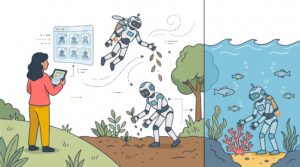
I think three new roles are on their way: the digital twin manager, the carbon fraud lawyer and, a little further out, the robot rewilding manager. Each one exists because someone has to ask whether the system’s decision is right for the situation. If you want to know where future jobs will come from, look at the gap between what a system says it can do and what it actually does. The work is changing. Your judgment about what matters isn’t.
3. Protect your thinking.
In 2025 a client told me I’d become curt and efficient. They were right. I was running four large language models and ten AI tools, feeding the answer from one into the next, and I’d lost the ability to make a decision on my own. It now has a name: AI brain fry. The law is heading the same way. France gave workers a right to disconnect in 2017, and the EU’s proposed Quality Jobs Act looks at protecting attention during the working day. Use the tools, absolutely. But they’re subordinates, not your friends. Turn most notifications off, and agree with your team when you’re available and when you’re not.
4. Talk to your colleagues.
In October, Harvard Business Review published research on what it calls “relationslipping”: teams getting weaker as people ask AI instead of each other. Where that’s the norm, coordination and trust both drop by more than 20%. Where teams stay in daily contact, coordination goes up 28% and trust 19%, even with AI in the mix. One CEO put it to me this way: “The systems are connecting, but the people are forgetting to connect.”
During the session, we asked you to fill in the WallWork cards. The room included a former fireworks shop worker and someone who puts ketchup on pasta. In a few years these will be your colleagues, so it is worth knowing who they are today.
5. Remember what it’s for.
When you’re down in the weeds with repetitive tasks or tedious administration, it’s easy to forget that the work you’re about to embark on keeps the planet liveable and accoutable. That’s no small thing.
We can’t be future-proof, because that would mean knowing exactly what’s coming. But with a bit of foresight, we can be built to thrive.
Resources:
- How to develop a Synthesising Mindset
- Living Supply Network Prototype
- How to make your own Prototype
- AI Brain Fry Infographic
- MattOS – How to ensure you stay in charge as the machines get more advanced
Any questions – just reach out. Stay curious and stay human!