
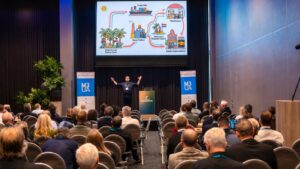
 Notes from my keynote at M3UA Benelux, Eindhoven
Let’s start with hagelslag.
Picture the shelf in an Eindhoven supermarket running low. Behind it is a chain that starts on a cocoa farm in Ivory Coast, goes through a jar factory in Germany, crosses the sea on a container ship and ends in a warehouse. Then a gas price spike shuts the jar factory. In the future I described on stage, M3 spots the problem, finds an alternative supplier and puts the options in front of a person. A human still makes the call.
To show what that might look like, I built a “living supply network” in an afternoon using an LLM, with no coding background. It runs on simulated data. It isn’t a product and it isn’t for sale. But if one person can do that alone, think about what this community could build together.
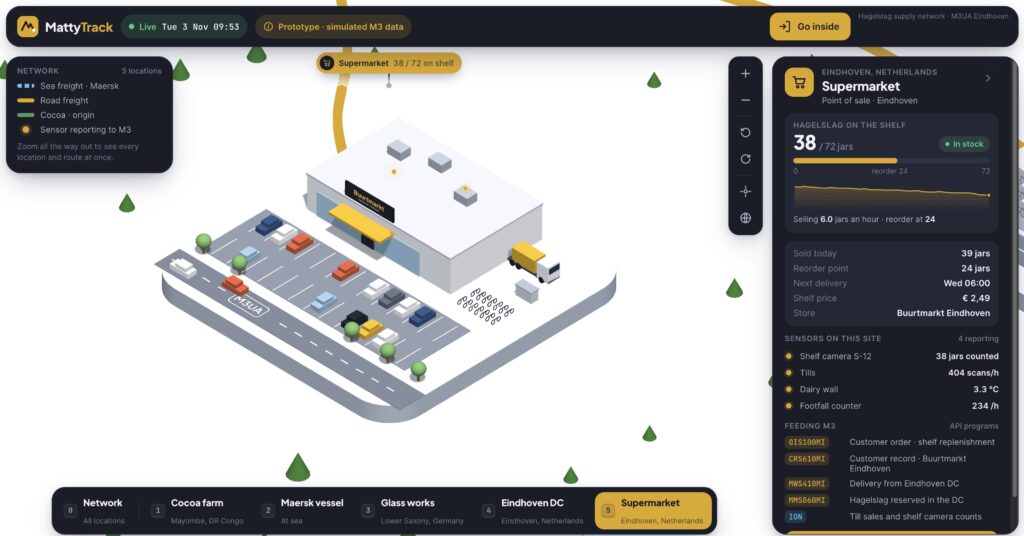
The Dutch Supermarket – End of the Chain!
Here’s what I asked the room to take away.
1. Experiment, but bring people with you.
Try this kind of thing with your team. Before you go near real data, talk to your ERP partner and your legal team.
2. Watch the gap.
I think three new roles are on their way: the supply chain exception manager, the AI agent supervisor and, a little further out, the robot fleet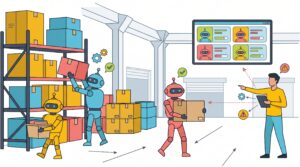 manager. Each one exists because someone has to ask whether the system’s decision is right for the business. If you want to know where future jobs will come from, look at the gap between what a system says it can do and what it actually does. The work is changing. Your judgment about what matters isn’t.
3. Protect your thinking.
In 2025 a client told me I’d become curt and efficient. They were right. I was running four large language models and ten AI tools, feeding the answer from one into the next, and I’d lost the ability to make a decision on my own. It now has a name: AI brain fry. The law is heading the same way. France gave workers a right to disconnect in 2017, and the EU’s proposed Quality Jobs Act looks at protecting attention during the working day. Use the tools, absolutely. But they’re subordinates, not your friends. Turn most notifications off, and agree with your team when you’re available and when you’re not.
4. Talk to your colleagues.
In October, Harvard Business Review published research on what it calls “relationslipping”: teams getting weaker as people ask AI instead of each other. Where that’s the norm, coordination and trust both drop by more than 20%. Where teams stay in daily contact, coordination goes up 28% and trust 19%, even with AI in the mix. One CEO put it to me this way: “The systems are connecting, but the people are forgetting to connect.”
Before the session, we asked you to fill in cards. The room turned out to include a beekeeper, someone who trains police dogs and one of the first windsurfers in the Netherlands. That’s what a user group is for: comparing notes with people, not job titles.
5. Remember what it’s for.
When you’re down in the weeds of an approval queue or a stubborn integration, it’s easy to forget that M3 keeps the world fed, clothed and serviced. That’s no small thing.
We can’t be future-proof, because that would mean knowing exactly what’s coming. But with a bit of foresight, we can be built to thrive.
Resources:
- How to develop a Synthesising Mindset
- Living Supply Network Prototype
- How to make your own Prototype
- AI Brain Fry Infographic
- MattOS – How to ensure you stay in charge as the machines get more advanced
Any questions – just reach out. Stay curious and stay human!