
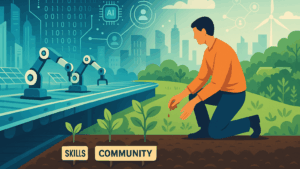
 Automation is accelerating. But trying to guess exactly which jobs disappear when is a waste of time. McKinsey reckons 14% of jobs globally could be automated by 2030. Other studies throw out numbers anywhere from 9% to 47%, depending on the sector and how fast things unfold. Truth is, we don’t know. History shows that technology tends to kill some jobs and create new ones – but those transitions can take decades, and they’re never smooth!
So let’s stop guessing and start preparing.
Whether 15% or 50% of jobs are automated in the next 10 years, these strategies will help you stay ahead of the curve.
If you just want the gist:
- Start building a second income stream, even if it’s tiny.
- Learn the kind of skills machines can’t copy.
- Stay connected with people around you, they matter more than ever.
- Own your data, or at least know who’s using it.
- Change is coming either way. Better to be ready than caught off guard.
Build Multiple Income Streams
Relying solely on a job for income is starting to look risky. But building alternatives doesn’t mean becoming a full-time investor or needing a pile of cash.
Start small. Things like:
- Credit unions that pay 1 – 3% dividends to members. That’s better than most high street banks.
- Community-supported agriculture. You chip in a few hundred for a share in a local farm. In return, you get fresh food each week – and often a small profit if the farm does well.
- REITs (Real Estate Investment Trusts). These let you invest in property portfolios from as little as £20 – £100.
If you’ve got more time or confidence:
- Community solar. Buy a few panels in a shared solar farm and get credits off your energy bills. Usually pays itself back in 6 – 8 years.
- Peer-to-peer lending. Platforms like Kiva let you lend to small businesses. You’re supporting local economies and learning as you go.
None of these will replace your salary straight away. But putting £25 a month into one or two of them builds the habit. That’s what matters.
Focus on Skills That Work With Automation, Not Against It
Trying to outcompete AI or machines at their own game is pointless. Instead, focus on skills that complement automation.
Skills worth building:
- Judgment-based problem solving – especially where there’s no clear answer
- Creativity – bringing ideas together, writing, storytelling, visual thinking
- Interpersonal work – mentoring, therapy, education, community leadership
- Skilled trades – plumbing, electrical, maintenance – where environments are too unpredictable to automate
Ask yourself:
Imagine waking up tomorrow and half your job is done better by a tool you’ve never come across. What would you want to be known for then?
- What parts of your job could be automated in the next five years?
- What parts rely on human connection or complex thinking?
- Can you lean into the second group while preparing for the first?
Action steps:
- Spend 30 minutes a week trying out new AI tools in your field
- Take one online course a year that strengthens your “human” skills
- Volunteer somewhere you can practise soft skills that matter
Understand What Support Systems Already Exist
UBI (Universal Basic Income) gets talked about a lot. And while full-scale versions are still rare, governments are moving in that direction – slowly.
What’s already out there:
- Child tax credits and family support payments
- Universal healthcare in many countries
- Free or heavily subsidised community college and training schemes
- Expanded earned income credits for lower-wage workers
How to make use of it:
- Look up what programmes are available where you live. Don’t assume you’re not eligible.
- Follow pilots and local schemes – like “baby bonds” or public banking initiatives. Some of them fly under the radar.
- Don’t wait for Universal Basic Income (UBI). Build your own resilience assuming these systems will stay patchy – but vote for the ones that make sense.
Build Local Connections
As jobs shift and some disappear, community ties matter more. When work is no longer the main source of belonging, we’ll need other places to plug in.
Start small:
- Join a mutual aid group in your area. Look on Facebook or Nextdoor.
- Try a skills exchange platform where you trade time instead of money
- Rent a plot in a community garden. Most are affordable and surprisingly social
If you want to go further:
- Maker spaces. Shared workshops with tools, training, and creative people
- Learning circles. Free local groups that meet regularly to discuss new ideas
- Local investment clubs. Even if you don’t invest, you’ll learn loads
And for the long haul:
- Time banks. One hour of your time earns you one hour of someone else’s
- Co-housing or shared ownership models to keep housing affordable
- Community land trusts that hold property for long-term public benefit
You don’t need to join everything. Just find one thing that feels right for you. The aim is to have a place to go when traditional systems wobble.
Start Taking Back Your Data
Your digital footprint is worth a lot; to other people. But that’s starting to change. Slowly, people are gaining more control and more ways to benefit from the data they generate every day.
Right now, you can:
- Use the Brave browser or DuckDuckGo for more private browsing
- Check privacy settings on your apps once a month
- Try a decentralised social platform like Mastodon or Bluesky
What’s coming:
- Data co-ops where users pool data to negotiate better terms
- User-owned platforms like Stocksy or Resonate, where members get a share of the profits
- Prediction markets that pay for accurate forecasting
This will take time to mature – but if data is the new oil, it’s worth knowing how to dig!
Plan for Messy Transitions
Economic change is never clean or fair. It’s slow, unpredictable, and often hits the wrong people first.
If you’re financially stable:
- Build 6 – 12 months of savings
- Slowly diversify your income streams
- Get curious about automation in your industry
- Support community-level projects where you live
If money’s tight:
- Focus on building flexible skills, not investments
- Look into free training or upskilling options
- Join a mutual aid network – being useful builds goodwill
- Strengthen relationships with neighbours, family, and coworkers – (I am part of a few community WhatsApp groups.)
If you’re already in transition:
- Claim all available benefits and support immediately
- Talk to local workforce programmes – they often have more than you’d expect
- Look at gig work as a short-term bridge
- Don’t isolate – most people are more understanding than we give them credit for
What Might Not Work
Some strategies might fail depending on where you live, who you know, or what you’ve got to start with.
Potential issues:
- Some communities don’t have the resources to set up co-ops or local projects
- Reskilling takes time that many people don’t have
- Government programmes can be fragile – one election away from vanishing
- The pace of change could still outstrip our ability to adapt
Plan B:
- Be willing to move if the place you’re in is stuck
- Reconnect with family or long-standing networks if things get tight
- Learn basic self-sufficiency skills – gardening, repairs, cooking from scratch (YouTube is a good start)
The Bigger Picture
This isn’t just about jobs. It’s about how society is structured. If work stops being central to survival, we’ve got a chance to rebuild something better.
What could come next:
- Shorter working weeks as standard
- More shared ownership of the things that generate value
- Universal services that reduce pressure on households
- New ways to feel useful that aren’t tied to a payslip
It won’t all be smooth. But this kind of disruption also clears space. It forces us to ask better questions.
Getting Started
You don’t need to do everything at once.
This month:
- Try one automation tool related to your job
- Join a local group that matches your interests
- Set up a simple alternative income stream – even if it’s just a tenner a month
This year:
- Learn one skill (prompt framing for example) that works alongside machines
- Build relationships with three or four people you trust locally
- Explore one new idea around ownership, community, or data rights
And beyond:
- Keep an eye on what’s changing – technically and socially
- Share what you’re learning. Help others do the same
- Stay open. Stay human. Be part of building what comes next
What’s the one part of your work that no machine could fake? That’s where your future value lives.
The future is being built either way. Better to shape it than wait and see what happens. Feel free to reach out to me with questions or fresh ideas!